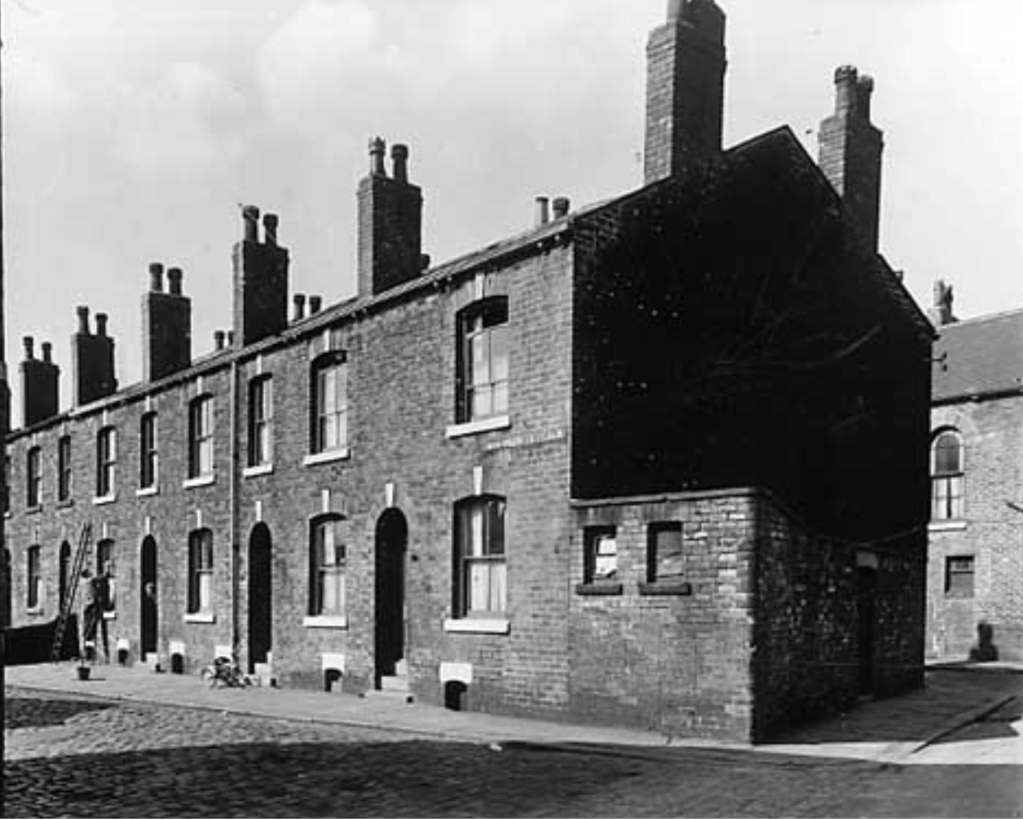
Harry was born on 29th January 1893, the only child to Arthur and Emily Sykes (nee Brown). The couple were living at 6 Mayflower Place, Hunslet. Arthur worked as a driller – engineer, sadly, Emily died 4 months after giving birth on 14 May 1893 at Killingbeck Hospital from Smallpox. Arthur married Esther Bucktrout in March 1894, but Esther must have already been 5 months pregnant as they had a baby, Gertrude, in July 1894. Another daughter, Nellie, followed in 1896. Harry would therefore have been brought up by his step mother and had two younger half sisters.
War was declared in August 1914, young Harry was working as a brickyard worker. It was 6th April, 1915 when Harry attested to the 2/7th West Yorkshires. Harry’s poor eyesight is noted, he also spent some time at the Norfolk Eye Hospital as he had a corneal ulcer on the right eye, although was not admitted to Norfolk. Harry’s eye problems would see him admitted to military hospitals several times throughout his service.
The 2/7 West Yorkshire (Prince of Wales Own) was raised in September, 1914 in Leeds. In March 1915 they would go to Matlock, where they would join the 185th brigade, 62nd (2nd West Riding), this is where Rifleman Sykes would have started his service. By October 1915 they moved to Retford, November to Newcastle and Salisbury Plain in January 1916. In June, 1916 they moved to Somerleyton in Lowestoft, it was here Rifleman Sykes was first admitted to a hospital with his eye condition. On 29th June, 1916, he was admitted to Somerleyton Detention hospital with a “long suffered” corneal ulcer. Rifleman Sykes spent 5 nights in the hospital and re-joined his battalion. In January 1917, after almost two years of service in the UK, Sykes would proceed to France, landing in Le Harve.
Just one month after arriving in France, in February 1917, Sykes would be involved in the fighting at Ancre, this would be one of many battles he would take part in, including: Arras Offensive, Hindenburgh Line and Cambrai 1917. In June 1918, the battalion was severely reduced and returned to England to be absorbed into the 18th York & Lancaster.
On 10th September, 1918, Rifleman Sykes had more problems with his eyes, he was admitted to Haxby Road Military Hospital, York, where he was admitted for 9 nights. Upon his release from hospital, Rifleman Sykes was transferred to the 406th Agricultural Coy, along with a new service number of 236960, this was most likely because his previous battalion had left for Bourlogne whilst Sykes was in hospital. The agricultural companies generally were manned by those who had been downgraded due to medical reasons, often working on farms under the mantra “no labour, no battle.”
In February, 1919, Sykes was re-admitted to Haxby Road Military Hospital at York. This time it wasn’t with his eye, but he had contracted Spanish flu and double pneumonia, which would take his life on 13 February. Sykes’ military note state that his family were present, his father claimed his sons body and Rifleman H. E. Sykes was laid to rest at Hunslet (Old) cemetery in Leeds. Sykes’ military record is impeccable, with an entry stating “certified no entry serving in my company.”

 The Stories Behind the Stones
Leave a comment