Tag: Women

  • “The business of an explosive is to explode”: How the women of Leeds helped win the war
    “The business of an explosive is to explode”: How the women of Leeds helped win the war

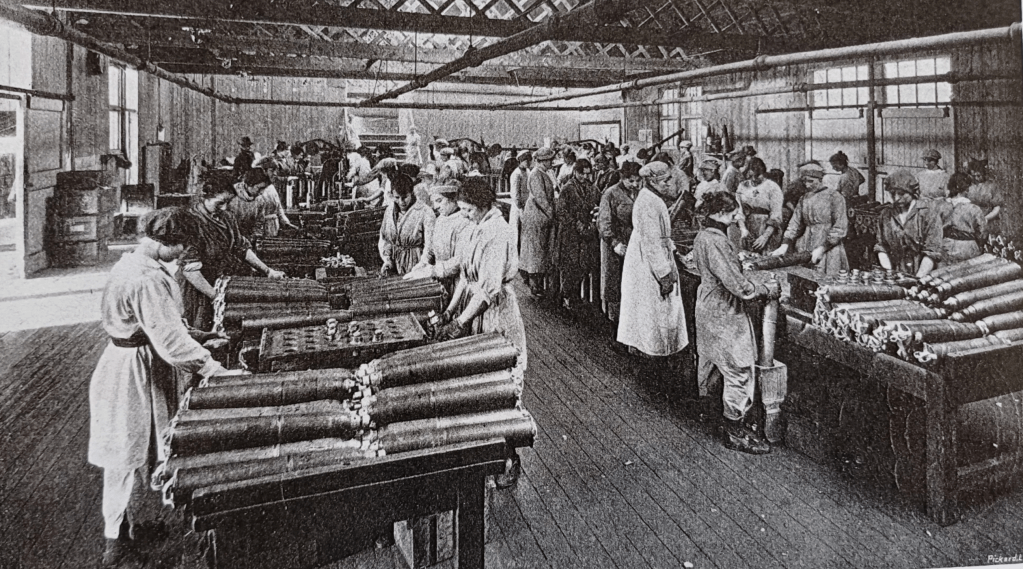
    This is the story of the Barnbow, a munitions factory that was not only crucial not only the war effort, but challenged social problems such as gender inequality, poverty and the role of women in society. Over a series of blogs, we will learn not only about the factory, its role in the war and about the women who worked there.

    The Shell Crisis.

    The onset of the first world war resulted in an increased demand for bullets, shells, grenades and bombs. European allies identified that their armies could not keep up with demand and that this was a major factor in the war not being “over by Christmas.”  Britain alone could not meet the demand to produce enough artillery for its efforts on the Western Front. During the Boer War, and in peacetime, the Royal Arsenal at Woolwich made and supplied ammunition for the British Army, but of course the country was unprepared for the Great War, which was on a completely different scale. The demand for ammunition now exceeded the capabilities of the Royal Arsenal. Shells were rationed, with many soldiers on the front line only having a handful of shells per day. War cannot be won with a limited number of shells. Furthermore, the introduction of trench warfare meant that highly explosive shells were better suited than the shrapnel used in previous wars. Munitions factories would produce shells, and these would be used in guns that would dominate the  battlefields. All was good in theory, but in 1915 a “shell scandal” occurred when stocks of shells were low due to this new type of high rate shell fire over extended periods of time. The Battle of Aubers in May 1915 was a disaster to the British, who had 10 times as many casualties as the Germans. The Times war correspondent, Colonol Charles á Court Repington, informed the press that a severe lack of highly explosive shells was the cause of the failure at Aubers, stating “the want of an unlimited supply of high explosives was a fatal bar to our success”.

    A coalition government was set up, Kitchener remained tasked with setting up the new armies. A Ministry of Munitions was set up in response to the need to mass produce highly explosive shells. The Munitions of War Act 1915 guaranteed that an unlimited number of shells could be produced and the Germans would not be able to match the UK production. This meant new munitions factories would need to be built. One such site was

    Barnbow Royal Ordnance Site (ROC)

    National Filling Factory no 1, at Barnbow, then a tiny hamlet on greenbelt near Cross Gates, Leeds. The Barnbow site was chosen for its proximity to Leeds and other surrounding towns such as Selby, York, Pontefract, Castleford and Wetherby. An existing Leeds to Selby/York railway line passed to the south of this site, but the closest station was a mile away. A new stop was built to the site, with 38 special trains a day from as far as York and Knaresborough bringing 16,000 workers to the site. These trains were called Barnbow specials and were crucial to transport employees to National Filling Factory no 1. Free travel passes were provided to personnel, enabling them to travel to and from work.

    The site covered 400 acres and was leased from Colonel Gascoigne of Partlington and Lotherton. The site included the existing Shippin House Dairy Farm, this was intentional as 300 gallons of milk per day was required for the workers to drink, an attempt to flush out the toxins ingested from the explosives that turned their skin yellow, thus earning the women  who worked there the nickname “Barnbow Canaries”. Milk was rationed in the UK at the time, but Barnbow employees could drink unlimited quantities.

    With men away fighting, up to 93% of the factory’s 16,000 employees were women and the work they did was extremely dangerous. Cordite is an explosive, it was traditionally used to fill the bottom half of a shell. At Barnbow, an experimental substance called Amatol was used, this was a compound of TNT and ammonium nitrate, which meant it was even more explosive. Cordite would cause sore throats, eye and stomach problems and would turn the skin yellow. It was possible for women to die from TNT poisoning (and some did) and there was always a real risk of an accidental explosion. Yellowing of the skin earned these women the nickname “Barnbow Canaries”. Clearly, this was highly dangerous work, so the wages were good. Employees working in the explosive “danger rooms” could initially earn £3 a week, which taking inflation into account is £250, however, once a bonus scheme was introduced, many women were earning £12 a week, so £1000 a week. At the time, it wasn’t unusual for women to have not worked outside the home, but those who had would have earnt pennies as housemaids or shop workers. The difference in pay was considerable and many women felt empowered and independent for the first time in their lives, furthermore, they were also contributing to the war effort just like their husbands were.

    This work posed a real danger to the women, who accepted as part of their patriotic duty, just like the men if their lives accepted the dangers of going to the front.

    Barnbow “city”

    The Barnbow site was a little city in itself. In addition to the dairy farm, land was also used to grow crops, a slaughterhouse and butchers would provide meals for the staff canteen. Meals were provided for workers on their 45 minute break, with three canteens producing healthy nutritious meals for 4,000 workers per sitting, A special canteen concentrated on feeding the 1000 workers who worked with the most dangerous poisonous materials.  Any food waste was fed to the pigs who were then slaughtered, butchered and fed to workers. Malnutrition was a real problem for working class people from the industrial cities during the time of the Great War, these were people who grew up in Victorian times, 200 tons of potatoes were grown on the farm at Barnbow to feed the workers, an attempt to keep them healthy to enable them to work. Affordable, healthy and plentiful meals as a benefit of employment was part of the attraction of working at Barnbow, a tool used in the recruitment process. Women never had to feel hungry again and could afford to feed their children, even whilst their husbands were away.

    The factory housed Medical and dental facilities, consisting of a resident doctor, two dentists and several nurses. Many workers would have never had affordable access to good quality medical care, many would have never seen a dentist before. Again, this was used as a hook to attract workers to the site. Word “got around” that the dentists were skilled, careful and patient, they were very busy indeed.

    The Medical Room at Barnbow

    Emergency services were set up on the site, also run by a team of women. A garage maintained the passenger cars and ambulances, which were driven by female chauffer’s from the Women’s Legion. A fire service was established, again staffed mostly by women trained on site by a fire master who came up from London. A 300,000 gallon reservoir was constructed on the north of the site, to which two fire pumps were connected. A beck ran through the site and this was dammed to provide storage ponds for firefighting equipment.

      The textile industry in Leeds factories would provide material for exploder bags, silk bags, cotton twine and uniforms, with  the well established textile factories in Leeds supplying all the filling factories in the UK. Ex military personel from the Royal Defence Corps and police were recruited to patrol the site, which was surrounded by a barbed wire fence. A female superintendent was recruited to police  the women during searches. The most dangerous areas of the filling station were under continuous survellience. The entire area was under complete censorship, workers were not allowed to disclose the location, the media were not allowed to report on it.

    Employees worked 48 hours a week, covering 6 days a week. Holidays were not allowed. Strikes were not allowed. All personnel were subjected to strict medical checks upon recruitment and health checks throughout their employment. Women employed in the TNT rooms were further medically examined, given that they were at risk from poisoning. Female welfare workers checked in on employees, often during mealtimes. Women were encouraged to eat healthily and to take a pro-active approach towards their own health and fitness, with tennis courts on site to promote recreation. Many women working at Barnbow were from inner city areas and malnutrition was a major feature of their life. Many did not have access to healthcare, dentistry, vitamins, healthy food and recreational spaces.

    Strict processes and procedures had to be followed daily. Of course, the exact location of the site was top secret, workers were sworn to secrecy. Thorough practices were in place at the start and end of each shift. Some of these procedures  protected workers against accidental explosions, others protected the site against enemy attack. At the start of a shift, women were searched and had to strip down to their underwear. A uniform of a smock, cap and rubber soled footwear, along with a workers metal identity tag was provided. The colour of the uniform determined which department they worked on, with red meaning they worked in the most dangerous rooms. Any personal items had to be placed into a locker, Matches, cigarettes, jewellry and hair pins were strictly forbidden and regular random searches were made. Any person found to be breaking the rules, or in possession of forbidden items, would be presented to Barnbow’s specially convened magistrates court and would face a hefty fine. It was said by employees that it took 40 minutes at the start or end of a shift to prepare or decontaminate and follow procedures. Safe smoking areas were created, smoking was not allowed within the factory, This is an everyday practice now, but during the time of the war, it was commonplace for people to smoke at work and in situations we now consider dangerous. The last thing the country needed was for the munitions factory to blow up due to staff smoking!

    The explosives

    The site produced 10,000 tonnes  of explosives per week, and daily this needed 8 locomotives, 600 trucks and 70 ponies to move them to where they were required. Strict protocols meant that  accidents were thankfully rare, but unfortunately they did occur and the outcomes were disastrous. Firstly, four workers died from TNT poisoning, a future blog will tell the stories of these ladies. Secondly, three explosions at the site happened during its time. On 21 March, 1917, an explosion killed 2 women, a year later one woman and three men were killed on 31st March 1918, whilst the King and Queen were visiting Leeds. But the first explosion happened on 5th December, 1916, this was the most devastating as it resulted in the deaths of 35 women, with many other seriously injured.

    December 1916

    The night shift in room 42 on 5th December, 1916 started just like any other at 10pm. Just before half past, believed to be 10:27pm, a worker was holding a shell she was packing when it exploded. The explosion filled the room. Many of the women were clearly dead, others were screaming from their injuries whilst others were screaming for help or trying to find a place of safety.

    In a great act of bravery, worker William Parker entered and re-entered room 42 at least 11 times to carry out injured women. William worked as a Barnbow site mechanic and is credited with saving at least 12 lives that fateful night. Despite his heroic efforts and the many lives he saved, 23 women died instantly, their bodies were only identifiable by the workers identity tag. 12 more women died from their injuries over the coming days, many more were severely injured or disabled as a result of the explosion.

    The injured were taken to Leeds General Infirmary (LGI). Due to the nature of the site and the Defence of the Realm Act, a media blackout was maintained and the exact site of the factory was mostly unknown.  Even that staff at the LGI only knew that an explosion had occurred in a local munitions factory. The details and location of the site was kept from them. Medical Aid at the LGI was provided by the factory in the form of its own medical staff, the ambulance corps and the voluntary motor transport section, who provided ambulance services taking the women on the 6 mile trip to the LGI.

     It was of course almost impossible to keep a 400 acre factory total secret, it was also on the main Leeds to York railway line and could be seen as the trains pulled in and out of Cross Gates, people were aware there was something there but exactly what went on remained a secret the hid behind the tall perimeter fences. As a result, families of the deceased were simply told their loved one died in an accident at work, the complete media blackout meant that many wouldn’t be aware of the scale of the explosion. Of course, some word did get out about the explosion, but this was hearsay. It was only in December, 1918, just weeks after Armistice, that the media could finally expose what the factory produced and make a fragmented report about a fatal explosion. It was further five years before a detailed and true account of the incident could be published. The last thing Leeds needed was the Germans finding out the co-ordinates of the site, they were already sending Zepplins over Leeds!

    On the night of the explosion, the residents of Lazencroft Farm reported witnessing crowds of female workers with bright yellow faces, they were rushing to safety along Manston Lane. It was clear that the women were highly distressed. Lazencroft Farm residents were not told what had happened and were also sworn to secrecy, but they could clearly see there had been some sort of distressing incident. Lazencroft residents reported that the women were keen to get back into the factory to continue their dangerous work once the bodies were recovered and the injured taken away. All three times an explosion happened, factory production did not pause and workers went back into the explosive rooms as soon as bodies were recovered and the equipment was declared safe – usually within hours. Production only ever stopped once, that was on 11 November, 1918 at 11am.

    Post Traumatic Stress was unheard of, although clearly, many women were “shell shocked” after witnessing the explosion. Thirty-five people died that night and 9 more deaths are known to have occurred as a direct result of working at the factory. No official account of the incidents were ever made, no service medals were awarded to these women, who had played a vital role in winning the war, their work as dangerous as that of their male counterparts. Armistice brought no “Victory Parade” for the women who had made the shells used in battle. No war graves for the women who were killed. These women were soldiers, working in extremely dangerous conditions, they were poisoned because of their work and some gave their lives for King & country. Just like the men at the front accepted the dangers of war as their patriotic duty, the Barnbow Canaries also accepted their work as their contribution to patriotic duty.  The war could not have been won without the women of Leeds and it’s surrounding towns accepting danger, been poisoned and giving their lives. Allied troops would have been defenceless without their efforts.  Whats more, when the war ended, these women had to give up their newfound freedom, their wages and power they had sampled whilst their husbands were away. The men were decorated and commemorated, the women almost swept under the carpet. The Barnbow Canaries had shown they could do work that equalled that of a man, they were never recognised or received praise, but over hundred years on, we recognise and remember them.

    Field Marshall Sir Douglas Haigh did however issue a Special Order of the Day from the British HQ in France, he paid tribute to the devotion and sacrifice of all munition workers. Later, a Roll of Honour titled “They died serving” was placed in Manston Park,  Cross Gates, about a mile away from the site.

    After the war

    It has been calculated that the factory produced over 85 million pieces of munition during its three years of existence. During the 1920’s, the site was used for storage of surplus war material,  such as dismantled plant, blankets, war uniforms etc. In 1924, the lease ended and the site was handed back to Colonel Gascoigne, who then submitted a claim to the War Compensation Department for payment for the governments occupation of his land. In the present day, the new “East Leeds Orbital” (ring road) cuts through the east of the site, which opened in 2022 and is called William Parker Way, after the heroic mechanic who endangered his own life many times to save the women. A bridge over the new road is also named after him. Some of the land is considered “waste” and is recognised as a heritage site, so cannot be built on. Ridges in the land can be seen, some old stones and stone posts marking possible entrances, the long clear paths of today possibly sited where the trainline was extended. The site is peaceful, except for the sound of traffic from the East Leeds Orbital.

    In the Second World War, a smaller munitions factory was built a mile away at Barnbow, this site famously made tanks including the Centurian, Chiefton,  Challenger and Challenger 2, amongst others. The factory included a test track for tanks and this was just visible through the fencing. The Cold War resulted in a great demand for these tanks, but in the mid 1980’s Thatcher’s government privatised it and it was sold to Vickers. With the collapse of the USSR, and therefore the Cold War, production on the site decreased and the number of workers reduced from 3,000 at its height, to 400. In 1999, Prime Minister Tony Blair ordered the closing of the site and it finally closed in 2004.  At its height, “Vickers” (as it is locally known), was one of the largest employers in Leeds and was in an area of heavy manufacturing, with Charles H Roe coach and bus manufacturer being directly opposite,  The only building on the original Vickers site still standing is the Barnbow Social Club, which was originally built for the factory workers. The rest of the Vicker’s site is now a new (not yet completed) housing development, all the streets are named after the women who died in the 1916 explosion in the original factory just under a mile away. The original Vickers factory entrance is a red brick archway on Austorpe Lane just by the railway bridge. This has a blue plaque marking the work at Vickers.

    The next blog in this series will look at the lives of some of the women who gave their lives for King & Country, who were not celebrated or remembered.